Halting Climate Change Pathway to Decarbonization
At PGS Group, we recognize the urgency of climate change and take responsibility for our impact. As a manufacturing group relying on natural resources and energy, we are aware of our emissions and committed to reducing them across our operations and value chain.
At the same time, our circular products and services drive the transition toward a low-carbon economy. Through reconditioning and pooling, we extend product lifespans, avoid new material use, reduce waste, and retain stored carbon in wood for longer.
Climate change is a central pillar of our sustainability strategy and is embedded in our Climate Transition Plan; our roadmap to accelerate decarbonization and strengthen climate resilience.
Strategy Highlights
42 %
Carbon reduction target by 2030 (Scope 1 & 2)
25 %
Carbon reduction target by 2030 (Scope 3)
46 %
Energy mix covered by renewable energy

Towards a Net-Zero Future
Aligned with the 2015 Paris Agreement, we are committed to reducing CO₂ emissions in line with the 1.5°C pathway by 2050. Our organization has defined ambitious reduction targets on group-level versus a 2022 base year. In line with the principles of the Greenhouse Gas (GHG) Protocol, these targets reflect our commitment to measurable, science-based climate action:
- By 2030, reduce absolute emissions by -42% on Scope 1 & 2
- By 2030, reduce absolute emissions by -25% on Scope 3
"Accelerating towards a net-zero economy requires a joint effort. By working together, we can contribute to climate goals and help safeguard vital ecosystems for future generations." Luc Grauwet - CEO PGS Group

Measuring our Carbon Footprint
Each year, we measure our Corporate Carbon Footprint across all three Scopes to track progress toward our reduction targets. The assessment follows the GHG Protocol and is supported by an external GHG expert. We also continue to improve the quality and granularity of our underlying data.
As for most companies, the majority of our emissions fall under Scope 3, in our case, more than 90%, mainly linked to product end-of-life, goods for production, and transport.
Our annual measurements demonstrate substantial reduction in our overall Carbon Footprint over the last three years.
Taking Action for the Climate Our Carbon Reduction Plan
Before defining our emission reduction targets, we first analysed what would be realistic yet ambitious for the organization. To guide this process, we worked with an external consultant to develop a comprehensive Carbon Reduction Plan.
The plan revealed our key decarbonization levers across our operations and value chain, such as process efficiency, electrification, fuel switch, sustainable mobility, and supplier engagement. In collaboration with the management team, we then selected specific investments and measures to implement in the short, medium, and long term, assessing the potential impact of each action. This structured approach allows for targeted emission reductions across all three Scopes.

Shifting Away from Fossil Fuels Action Highlights on Scope 1 & 2
Over the past few years, we have already implemented substantial measures to reduce our direct emissions. A significant share of our fossil fuel consumption comes from company vehicles and heat generation for pallet drying, required for exports outside the EU and preferred in the food and pharmaceutical sectors.
- To reduce and avoid energy use, we apply natural air-drying in covered, ventilated areas.
- Biomass installations at seven major sites now replace natural gas in heating our dryers.
- R&D is exploring new renewable technologies to further reduce reliance on natural gas.
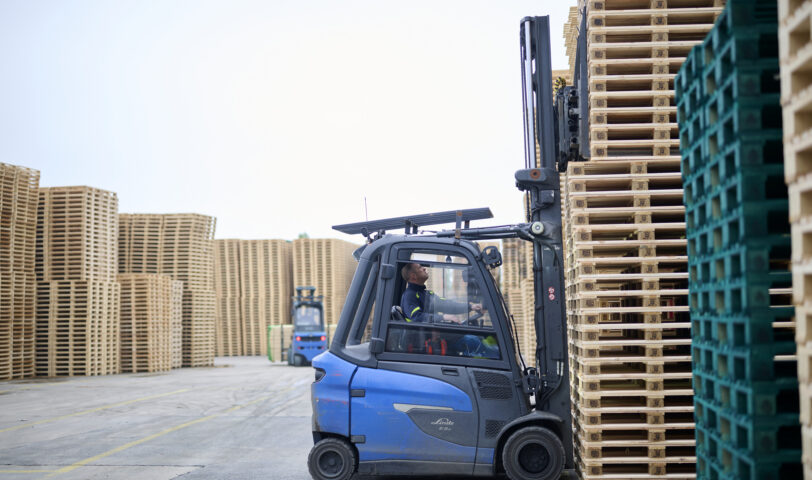
- Phase-out of fossil fuels by electrification of the company car fleet and on-site transport.

Transition to Renewable Energy Action Highlights on Scope 1 & 2
Another key pillar of our reduction efforts is accelerating the transition to renewable energy. We have achieved strong progress over the last years: 46% of our total energy consumption already comes from renewable sources, including 52% of our purchased electricity.
This progress has been achieved through:
- Maximizing on-site solar PV-installations.
- Signing green energy contracts in Germany, Denmark, the Netherlands, and Spain.
- Exploring a Virtual Power Purchase Agreement (VPPA) with Schneider Electric to cover the remaining sites.

Choosing Low-Carbon Material Action Highlights on Scope 3
Wood is the core material in our packaging products. Beyond its strength and reparability, it naturally stores carbon, giving wooden packaging a clear low-carbon advantage.
Metal is another key material. Through close engagement with our suppliers, the metal used in our nail production consists of more than 90% recycled scrap in 2025.
We also promote the use of compressed blocks in pallet production. Made from wood waste and glue, these blocks offer ecological advantages over solid wood blocks. However, our annual carbon assessment showed that the glue was a notable source of emissions. To address this, our R&D team is exploring the use of low-emission and formaldehyde free glues from our sawmill's byproducts.

Smarter Logistics Action Highlights on Scope 3
Transport is a key lever in our emission reduction efforts. Together with logistics partners, we advance low-carbon transport solutions and improve route efficiency.
- Modal shift: For long-distance routes, we replace road transport with lower-emission alternatives such as sea freight (Baltic–Belgium) and rail (Belgium–Southern France/Italy).
- Transport Optimization: Duo trailers increase load capacity on long routes, cutting CO₂ emissions by up to 30% per trip.
- Proximity advantage: Our network of 250 service centers in 14 European countries shortens average transport distances.

E-Mobility Action Highlights on Scope 3
For regional distribution, we are investing in e-mobility. In collaboration with our in-house transport partner 5G Multimodal, we launched a pilot project with Eutraco to operate an electric truck.
Starting in October 2025, the e-truck will cover approximately 75,000 km the first year, serving both inter-site transport and client deliveries.

Choose Sustainable Packaging
To support your decision-making process, we have developed a PGS Product Carbon Footprint (PCF) calculator that offers clear insights into the most sustainable new packaging option for your business. Together, we can reduce our environmental impact and advance toward a low-carbon economy.
Contact our sales team to explore how partnering with PGS can support your sustainability ambitions.
Transparent reporting
We are committed to keeping our stakeholders informed about our reduction in GHG emissions. By working together transparently and proactively, we can drive decarbonization across our value chain and contribute to a more sustainable future.
Follow our progress as we continue to advance on our pathway to decarbonization.
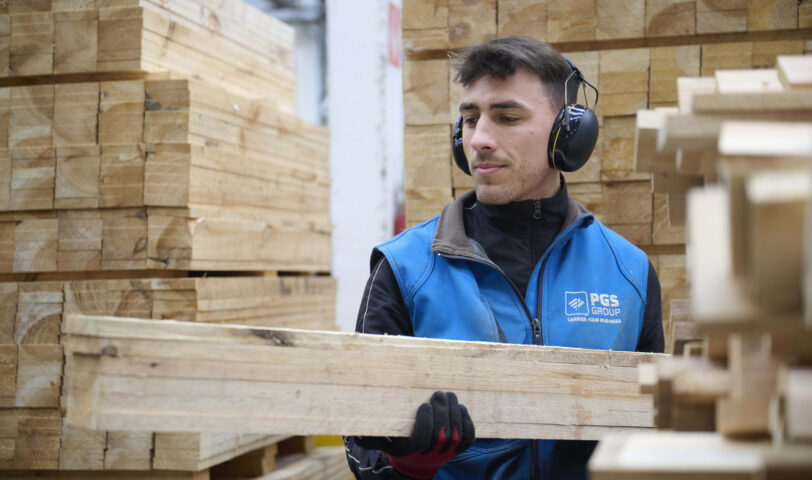
Safe and Healthy Work Environment
At PGS Group, safety is not just a policy, it’s part of our culture. From risk prevention and employee training to continuous improvement through audits and performance monitoring, our approach is built on responsibility at every level. Discover how we work toward our long-term goal of zero workplace accidents through practical measures, clear safety rules, and strong local engagement across all sites and roles.
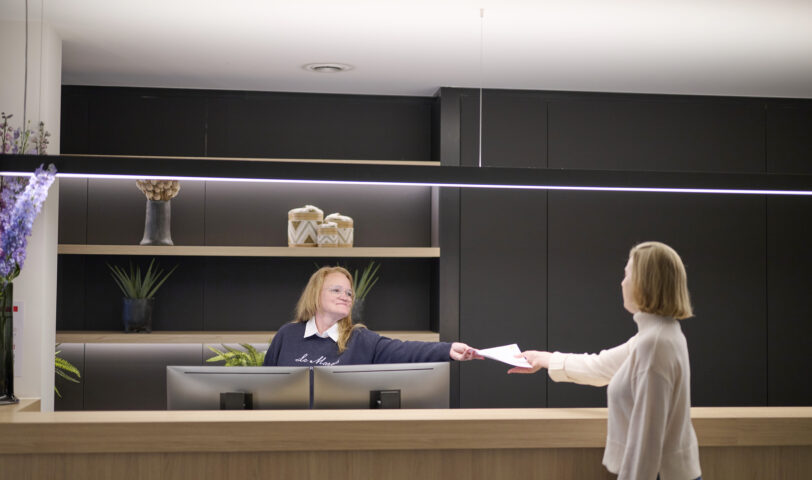
CSRD | Corporate Sustainability Reporting Directive
The CSRD sets a new standard for corporate sustainability reporting in Europe. At PGS Group, we see this as an opportunity to improve how we measure and manage impact. Learn how we are preparing, through double materiality analysis, data system upgrades, and a dedicated reporting tool, to meet future requirements with transparency and structure.
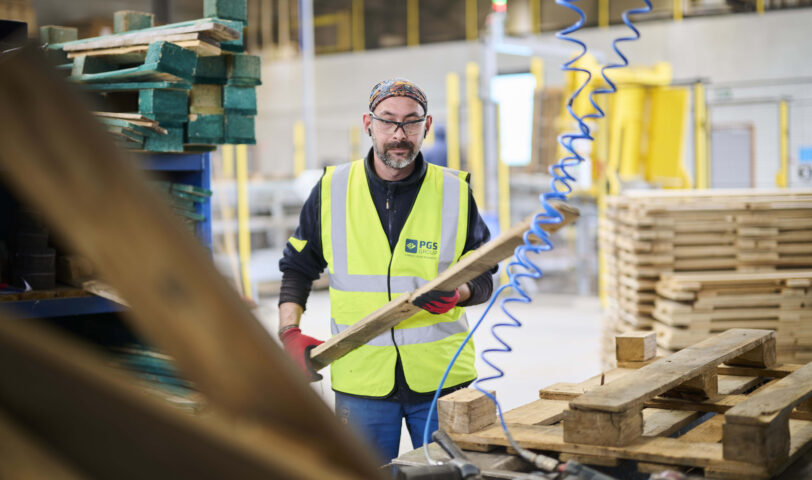
Circular Products and Services
Circularity is at the core of our business models. At PGS Group, we maximize material use through eco-design, repair and reuse services, pooling solutions, and the valorization of byproducts. Discover how our approach keeps resources in use longer, reducing waste and contributing to a more circular economy across the value chain.
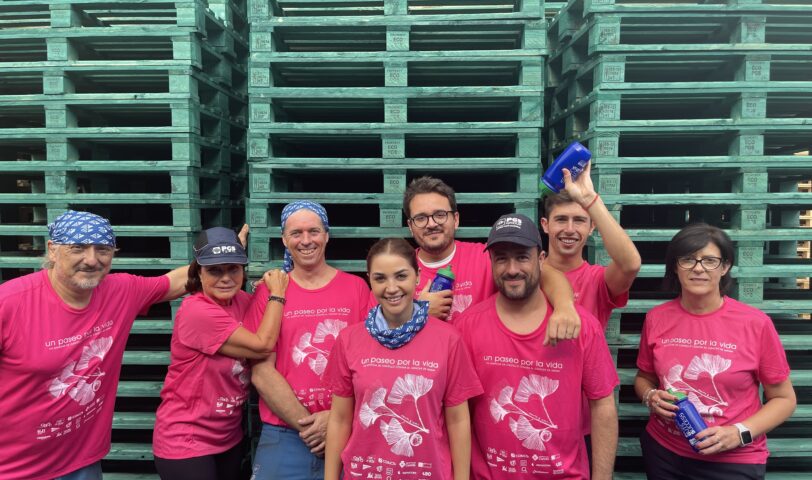
Dedicated Community Investment
We believe in social engagement and making a positive impact in the communities where we operate. Whereas we have always invested and engaged in our local communities, we wanted to keep track of our positive contributions in a more structural and efficient way. In line with this, we have established the PGS Community Investment Program. This program offers all of our employees the opportunity to support social projects and organizations.
PPWR | Packaging and Packaging Waste Regulation
The PPWR is the new European legislation for packaging placed on the EU market. It aims to reduce packaging waste, improve resource efficiency and strengthen the circular economy across the European Union. This article explains what the regulation means for transport packaging and wooden pallets, outlines the key requirements, and shows how PGS Group is preparing for its phased implementation.
Contact
Should you require further information or have any inquiries on our sustainability initiatives, we invite you to reach out to us at CSR@pgsgroup.com.